
Financial Therapy in Greensboro, NC
Money problems are rarely just about money.
What Is Financial Therapy?
Financial therapy is not what most people expect. It is not a session with a financial planner, and it does not involve reviewing your portfolio or creating a spending spreadsheet. What it does is help you understand the emotional relationship you have with money. The fears, habits, beliefs, and experiences that shape your financial behavior without you fully realizing it.
For many people, financial stress runs deeper than numbers. It touches identity, self-worth, relationships, and things that go all the way back to childhood. Chronic overspending, avoidance of bills, anxiety that spikes when money comes up, shame around debt. These are not just financial issues. They are emotional ones.
At A Path to Wellness, financial therapy blends emotional support with behavioral insight. The focus is on helping clients develop a healthier relationship with money, one built on awareness rather than avoidance, and on intention rather than reaction.
| Feature | Traditional Financial Planning | Traditional Talk Therapy | Financial Therapy |
|---|---|---|---|
| Focus | Assets & Growth | Emotional Wellbeing | The Intersection of Both |
| Primary Goal | Maximizing Net Worth | Mental Health | Financial Harmony & Behavioral Change |
| Addressing Trauma | Rarely | Yes | Yes (Specifically Money Trauma) |
| Conflict Resolution | No | General | Specific to Financial Disputes |
You might have a financial advisor for investments and a traditional therapist for mental health. A Certified Financial Therapist bridges that gap, integrating behavioral health with practical financial insight.
How Financial Therapy Can Help
Financial therapy addresses the emotional and behavioral side of money. The concerns people bring vary widely, but they tend to center on anxiety, avoidance, shame, or patterns that feel impossible to change on their own.
What Financial Therapy Works Through
Financial anxiety is more than worrying about bills. For many people it is a persistent, low-grade fear that follows them into sleep, into relationships, and into daily decisions. Stress around money can trigger avoidance, which makes things worse. Therapy helps break that cycle before it becomes entrenched.
Most financial behaviors are driven by emotional needs rather than rational choices. Spending can be a response to boredom, stress, anxiety, or a need for comfort. Saving patterns can be shaped by scarcity fears or family history. Understanding those drivers is the starting point for changing them.
Financial Trauma and Inherited Money Beliefs
Early experiences with money leave lasting marks. Growing up in a financially unstable household, watching parents fight about debt, experiencing poverty, or surviving a financial collapse as an adult. These experiences create beliefs and emotional responses that often operate below the surface well into adulthood.
Financial trauma does not require a single dramatic event. Chronic financial stress, ongoing instability, or simply inheriting the belief that money is always tight can create as much emotional difficulty as a sudden crisis. Therapy creates a space to identify and work through those patterns rather than continue carrying them.
Financial stress is also connected to anxiety, depression, self-worth, and identity. Addressing it often requires more than practical strategies. It requires understanding the person behind the financial behavior.
- Understanding how early experiences shape current financial behaviors
- Processing financial trauma and emotional residue
- Identifying inherited beliefs about money, security, and self-worth
- Rebuilding confidence after financial setbacks or instability
- Developing healthier emotional responses to financial uncertainty
- Reducing shame and self-criticism around financial history

Meet Dr. Tom Murray, CFT™
Dr. Tom Murray is a licensed therapist, practice owner, and Certified Financial Therapist based in Greensboro, NC. With more than two decades of clinical experience, he works with individuals navigating financial stress, anxiety, emotional spending, financial trauma, and the psychological patterns that shape financial behavior. His background in psychology, combined with his MBA and CFT designation, gives him an integrated perspective on the emotional and practical sides of financial health.
“As many of you know, I was a welfare-baby. Money felt tight, stressful, and full of limits. Those early lessons shaped how I saw money, success, and what felt possible.
Over time, I learned that changing income matters less than changing mindset. Learning how money works, how wealth grows, and how to set clear goals changed my life. That shift led me to business ownership, helping others with money stress, and earning my MBA.
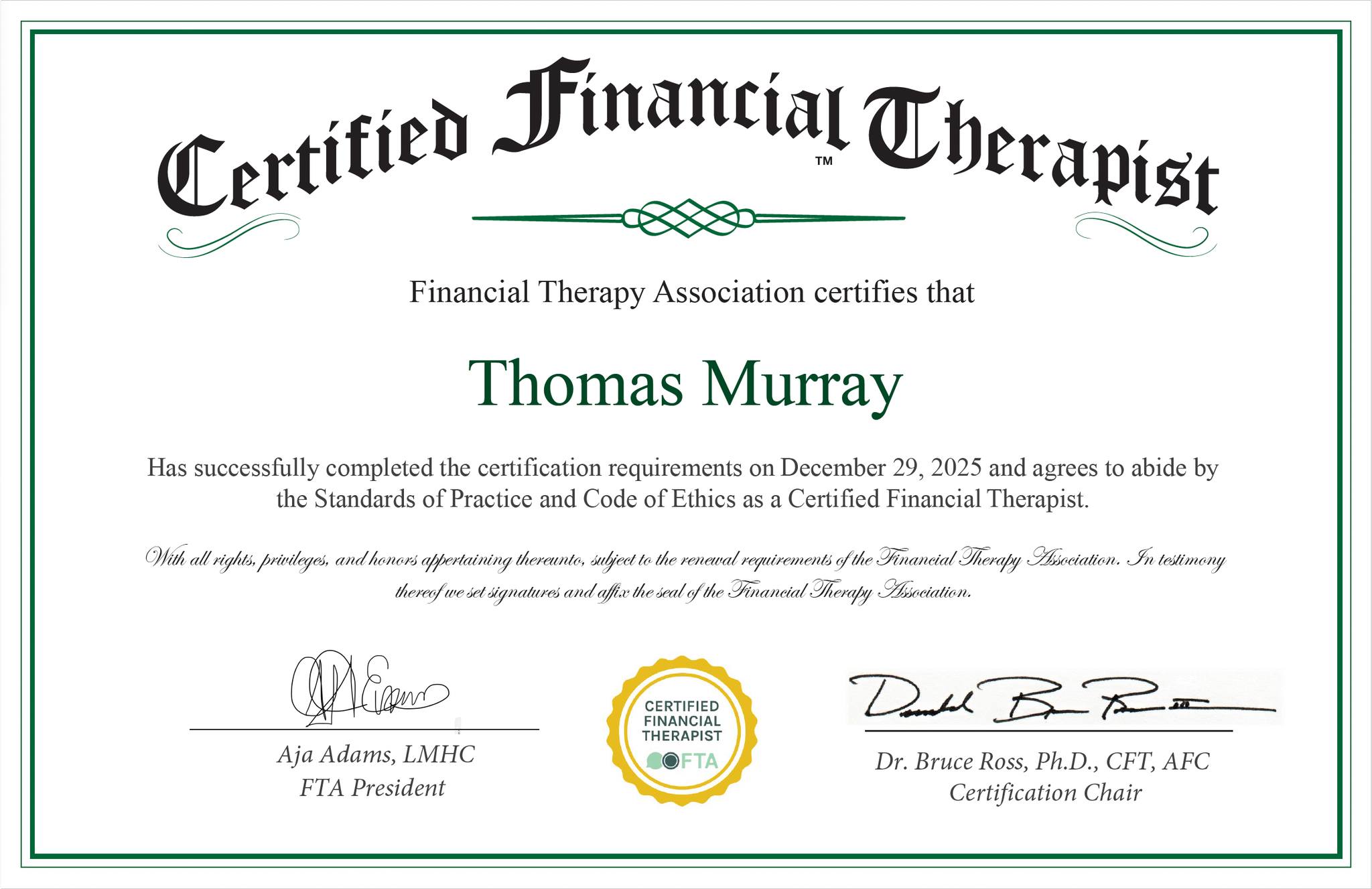
I have now completed the requirements for the Certified Financial Therapist designation. This work blends psychology, behavior, and practical money skills. It fits naturally with how I already help individuals, couples, and families.
I am grateful for the training and standards set by the Financial Therapy Association. This step deepens my ability to help people reduce money stress and build healthier lives.”
Virtual sessions available. Dr. Murray provides virtual financial therapy to clients in North Carolina, Pennsylvania, Oregon, and Florida.
Virtual Financial Therapy Available
Virtual therapy removes one of the biggest barriers to consistent care. No commute. No rearranging your schedule around office hours. You attend from wherever you have privacy and a stable connection. The therapeutic work is exactly the same.
For people managing financial stress, adding travel and scheduling complexity to an already overwhelming situation can make starting therapy feel harder than it needs to be. Virtual sessions reduce that friction.
- Access sessions from home, your car, or anywhere private
- Reduce scheduling barriers during stressful life periods
- Maintain consistent care without logistics getting in the way
- Attend from your own environment with full privacy
- Evening and flexible appointment times available

Working Through Financial Stress as a Couple?
Money conflict is one of the most common sources of tension in relationships. If financial disagreements are affecting your partnership, couples financial therapy offers a structured space to improve communication, reduce blame, and work through financial differences together.
Frequently Asked Questions
What is financial therapy?
How is financial therapy different from working with a financial planner?
Can financial therapy help with money anxiety and chronic stress?
Do I need to be in financial trouble to benefit from financial therapy?
Is financial therapy covered by insurance?
Do you offer virtual financial therapy sessions?
Ready to Build a Healthier Relationship With Money?
Confidential · Judgment-Free · HIPAA-SecureFrom Our Blog
Hot Topics
Real insights from our therapists on relationships, mental health, and the conversations most people are afraid to start.

Discernment Counseling for Couples on the Brink of Divorce
If you're unsure whether to stay or go, discernment counseling offers a structured, pressure-free path to clarity — without prematurely committing to either outcome.
Read More
Psychotherapy: Safe Haven for Emotional Healing and Development
Therapy isn't just for crisis. Discover how psychotherapy creates a safe, evidence-based space for healing anxiety, depression, trauma, and the challenges of everyday life.
Read More
Couples Counseling — From Conflicts to Connections
Conflict isn't the enemy of a strong relationship — how you handle it is. Learn how couples counseling helps partners move from recurring arguments to lasting connection.
Read More
Guided Growth: A Therapist's Guide To Post-Argument Reflection
What happens after the fight matters as much as the fight itself. A therapist's guide to processing conflict, repairing connection, and growing closer through disagreement.
Read More